
The immigration debate goes back as far as countries, peoples, and tribes do. Fear of the ‘other’ is not a new concept. Yet, here we are. Ever since Donald Trump made his statements about Mexicans coming across our border bringing drugs, crime, and rapists, immigration policy has been at the forefront of American political life. And now it’s the only issue on the table.
How did we get here and how do Hope and Fear play into this?
The Hope: Immigrants are coming to this country to make a better life for themselves and their families.
The Fear: Immigrants are coming to this country to sell drugs, rape women, and disregard our laws.
Like every political debate, the answer to this lies somewhere in between. On one hand, if we have no border security, people are free to come and go as they please without any accountability. On the other hand, if we have too much border security, America will close it’s doors to the tired and poor that Lady Liberty vowed to protect.
How legitimate are the Hopes and Fears?
Let’s turn to the facts: Most of the immigrants coming from Mexico end up in either Los Angeles, Houston, or Chicago. Around 26% of Mexicans that live in the United States live in these three places. The amount of people crossing our southern border illegally peaked in 2000 and has generally declined every year since. Since 2000 there has been an 81% decrease in apprehensions at the southern border as of 2017. (There are no concrete numbers given as to how many illegals cross into the country so those statistics are based off of the number of apprehensions at the border.) One can argue the exact numbers but the truth is that a lot of people have crossed our southern border illegally, but it has steadily decreased in the past 17 years.
There are a couple different types of illegal immigrants living in the United States: those that cross the border illegally and those that legally cross yet overstay their visa. A study done by the Center for Migration Studies reported that “44 percent of those in living in the U.S. illegally in 2015 were visa overstays”. This is an important distinction that often gets overlooked. The argument for the wall is that it will severely limit the amount of illegal immigrants coming into the country. Let’s grant the assumption that the wall, steel slats, fence, or whatever you want to call it stops all illegal immigration at the border. It still fails to address the 44% of illegal immigrants that overstay their visas.
One may argue that, although the wall wouldn’t stop the immigrants who overstay their visa, it is still worth stopping those crossing the border illegally. But believe it or not, Mexicans know how to build tunnels! Who’d-a- thunk? Unless Trump’s wall goes over 30 feet into the ground, people will find a way to cross the southern border.
So, why not let all of them in? Why not have open borders? (No, I’m not advocating for open borders. Just hypothetical questions.) Those who stress the importance of keeping illegal immigrants out of the country worry that they’ll come here, sell drugs, disregard our laws, and not pay taxes. Their argument would hold weight if it was borne out by the facts. So, what are the facts?
In 2015, the Cato Institute found that, “as a percentage of their respective populations, there were 56 percent fewer criminal convictions of illegal immigrants than of native-born Americans in Texas in 2015.” Other figures show that, places with higher percentages of undocumented immigrants have lower rates of crime:
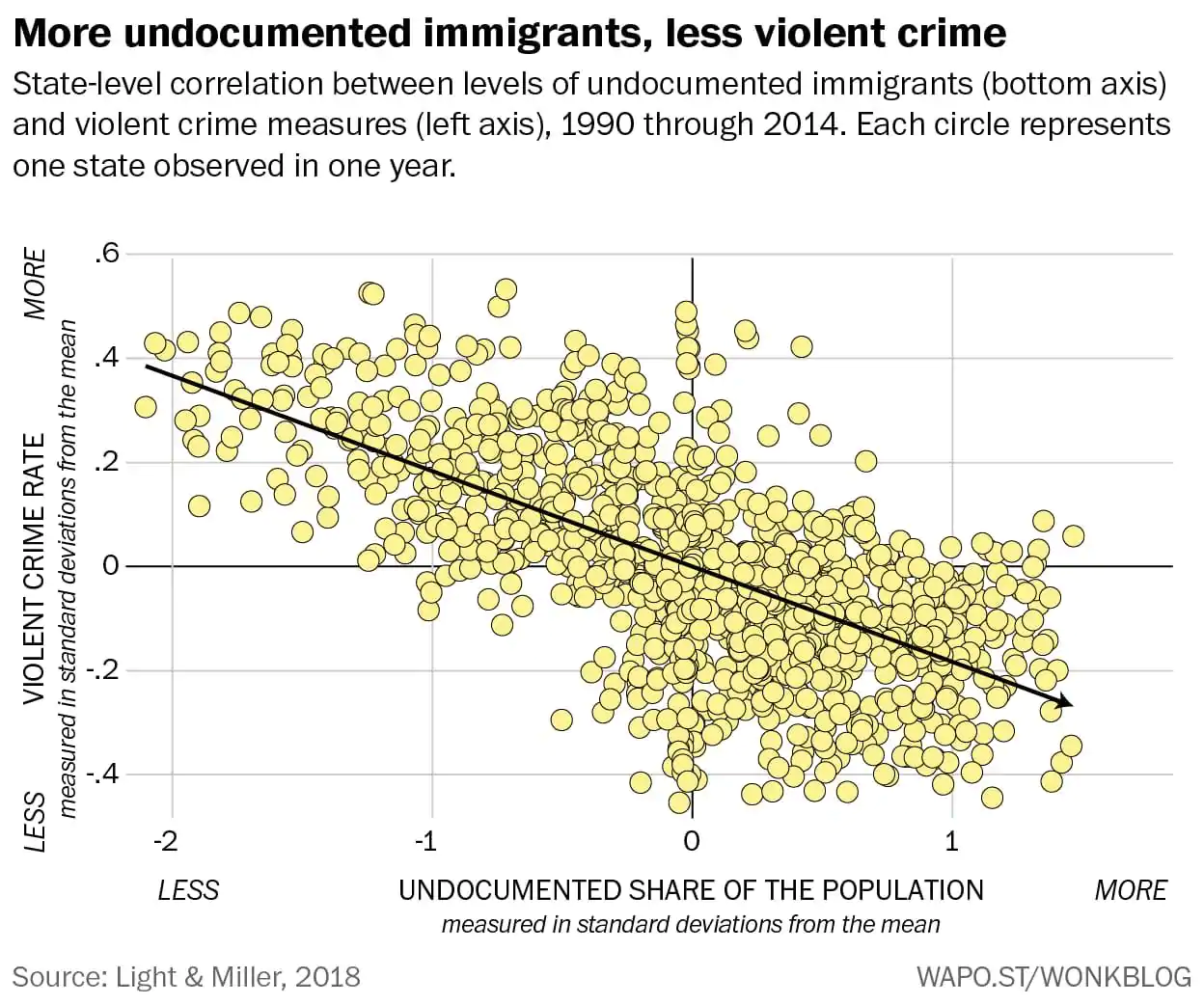
As for paying taxes, it is often assumed that illegal immigrants pay little to no taxes. I thought that myself. Yet, the Institute of Taxation and Economic Policy suggests that about “half of undocumented workers in the United States file income tax returns. The most recent IRS data, from 2015, shows that the agency received 4.4 million income tax returns from workers who don’t have Social Security numbers, which includes a large number of undocumented immigrants. That year, they paid $23.6 billion in income taxes.” Yes, billion with a b. And on top of that, many of the programs that these taxes pay for (social security, medicare, etc) aren’t available to them.
Another point of contention is what to do about those who cross the border, are apprehended, yet released into the United States to await their trial date in immigration court? This is a more difficult question and one that doesn’t have a clear answer. Many give the impression that once immigrants are released into the country, they’re never heard from again. And if you didn’t know otherwise, it would be a fair thing to assume. However, as Politico reported, “according to Justice Department data from the last five available years, around 60 to 75 percent of non-detained migrants have attended their immigration court proceedings.” That still leaves 25-40% that stay in the country illegally, however.
What are we doing about the 25-40% of illegal immigrants who don’t show up to their immigration court date? Should we be letting these people leave the immigration processing system before their immigration court date? Do we need better monitoring policies once these immigrants get into the country? Should we have better processing practices at the border so we don’t have as much time between people getting caught at the border and their immigration court date? Are walls effective at keeping illigal immigrants out of the country? These are all fair questions to ask, yet our political discourse is so fractured that we can’t even get this far in the debate.
All of the facts that I’ve presented paint a much different picture than what the President does. Yet even if you accepted all of these facts, you could still rightly argue that we need better border security. Everything should be on the table, wall included. But given the facts, shutting down the government and declaring our southern border a national emergency is a farce. If both sides were honest with eachother, we could at least start to have a conversation. Do we need border security? Yes. Should we deal with those crossing our border with compassion? Yes. Now, what do we do about it?
 Deconstructed Politics